

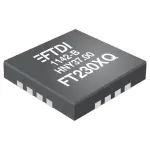
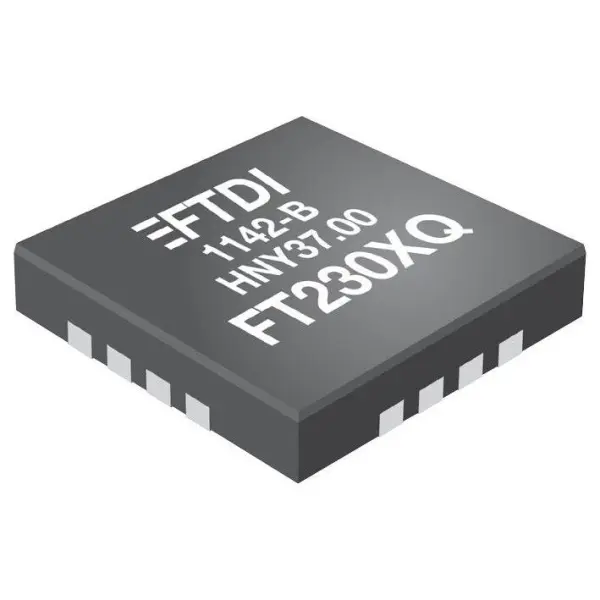
FT230XQ USB 2.0 to UART Converter IC, QFN-16
FTDI FT230XQ USB-UART converter IC. Single-chip solution with integrated EEPROM, supports 3 Mbaud data rate and 2.97-5.5V supply.
The FT230XQ is a fully-integrated USB 2.0 Full Speed integrated circuit that provides a compact and efficient bridge to basic UART (Universal Asynchronous Receiver-Transmitter) interfaces. This single-chip solution handles the entire USB protocol on-chip, eliminating the need for any USB-specific firmware programming and enabling rapid integration of USB functionality into system designs.
The device offers versatile data transfer rates ranging from 300 baud up to a high-speed 3 Mbaud, with a low typical operating current of just 8mA. It incorporates a fully-integrated 2048-byte EEPROM for storing device descriptors and configurable CBUS I/O settings, providing flexibility for custom applications. The inclusion of 512-byte transmit and receive buffers, utilising advanced buffer smoothing technology, ensures high data throughput and reliable communication.
Key Features and Specifications
- Integrated Design: Features fully-integrated clock generation with no external crystal required and internal 3.3V/1.8V LDO (Low-Dropout) regulators.
- Driver Support: Includes royalty-free VCP (Virtual COM Port) and Direct (D2XX) drivers, removing the need for custom USB driver development.
- Flexible I/O: Offers configurable CBUS I/O pins, transmit and receive LED drive signals, and configurable I/O pin output drive strength.
- UART Interface: Supports 7 or 8 data bits, 1 or 2 stop bits, and odd/even/mark/space/no parity options. Includes a UART signal inversion option.
- Advanced Interfaces: Provides synchronous and asynchronous bit-bang interface options with RD# and WR# strobes for greater control.
- Power Management: Supports bus-powered, self-powered, and high-power bus-powered USB configurations. Includes integrated battery charger detection to enable faster charging when connected to a USB port.
- Level Conversion: Integrates a +3.3V level converter for USB I/O, a
Need larger quantities? Need additional quantities? Get in touch and we'll arrange it for you.
- Shipped within 0-2 business days
- Shipping to United States: 3-5 business days*
- Free Shipping Included
Always follow local regulations and product guidance.
Free standard delivery on US mainland orders. Express delivery options and international shipping available at checkout.
We offer a 30-day money-back guarantee on most products. For defective items, contact us within 14 days for a replacement or refund.
View Full Delivery & Returns PolicySecure Transactions
We take the utmost care with your payment and personal details. Our website uses advanced encryption technology, including Secure Sockets Layer (SSL), to protect your information during transmission. You can verify a secure connection by looking for 'https' and a locked padlock in your browser.
Cookie Policy
Cookies enhance your shopping experience by keeping track of your cart and remembering you when you return. We also use banner advertising based on your browsing history to present products of potential interest.
Security Warning
Beware of phishing scams! We will never ask for personal details via email. If such information is required, we'll ask you to contact us by phone. If you receive an email requesting sensitive information, do not respond and let us know immediately.
You might like