

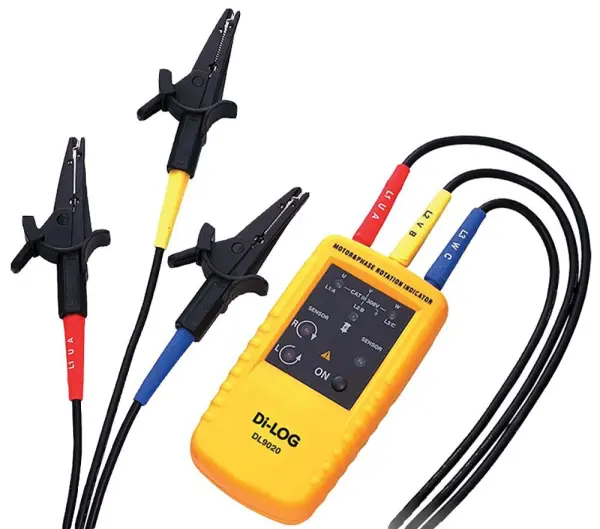
DI-LOG DL9020N Non-Contact Phase & Motor Rotation Tester, 400V
DI-LOG DL9020N handheld tester for contact-less motor rotation & 3-phase sequence checks. Ideal for industrial electricians. 400V AC range.
The DI-LOG DL9020N is a sophisticated, battery-powered handheld tester designed for the swift and safe diagnosis of three-phase electrical systems and motor rotation direction. Its primary innovation is contact-less detection, allowing you to ascertain motor rotation without needing physical access to the rotating shaft. This makes it an indispensable tool for motors housed within casings or located in hard-to-reach areas.
Engineered for demanding commercial and industrial environments, the instrument provides rapid visual indication of the rotary field sequence (phase rotation) and the corresponding direction of motor rotation. It is effective on both synchronous and asynchronous three-phase motors, covering a broad test frequency range from 2Hz to 400Hz. The device operates on a standard 9V PP3 battery, offering true wireless portability for use anywhere on-site.
Key Features & Benefits:
- Contact-Less Operation: Safely determine motor rotation direction without direct contact with the spinning shaft, enhancing user safety and convenience.
- Phase Rotation Indication: Quickly identifies the correct sequence (L1, L2, L3) of three-phase supplies up to 400V AC, crucial for proper motor installation and commissioning.
- Versatile Motor Testing: Suitable for determining the rotation direction of a wide array of three-phase motors, preventing potential damage from incorrect wiring.
- Complete Kit: Supplied as a full set, including 3x test leads, 3x test probes, 3x crocodile clips, and the required 9V PP3 battery, ready for immediate use.
- Compact & Portable: Its handheld, lightweight design makes it easy to carry in a tool pouch for daily use by electricians and maintenance technicians.
Need larger quantities? Need additional quantities? Get in touch and we'll arrange it for you.
Always follow local regulations and product guidance.
Free standard delivery on UK mainland orders. Express delivery options and international shipping available at checkout.
We offer a 30-day money-back guarantee on most products. For faulty items, contact us within 14 days for a replacement or refund.
View Full Delivery & Returns PolicySecure Transactions
We take the utmost care with your payment and personal details. Our website employs advanced encryption technology, including Secure Sockets Layer (SSL), to protect your information during transmission. You can verify a secure connection by looking for 'https' and a locked padlock in your browser.
Cookie Policy
Cookies enhance your shopping experience by keeping track of your basket and remembering you when you return. We also use banner advertising based on your browsing history to present products of potential interest.
Security Warning
Beware of phishing scams! We will never ask for personal details via email. If such information is required, we'll request you to contact us by phone. If you receive an email requesting sensitive information, do not respond and let us know immediately.
You may like